
On this page
A boiler delivers heat using water or steam. A furnace delivers heat using air moved through ducts. That is the basic difference, and it matters more than what either appliance looks like in the basement.
Neither system is automatically the better choice for every Northern Illinois house. Existing radiators or ducts, the condition of the distribution system, cooling needs, fuel availability, installation work, and household comfort priorities all belong in the decision. Replacing a heat source is one project; changing how the entire home receives heat is another.
How a Boiler Heats the House
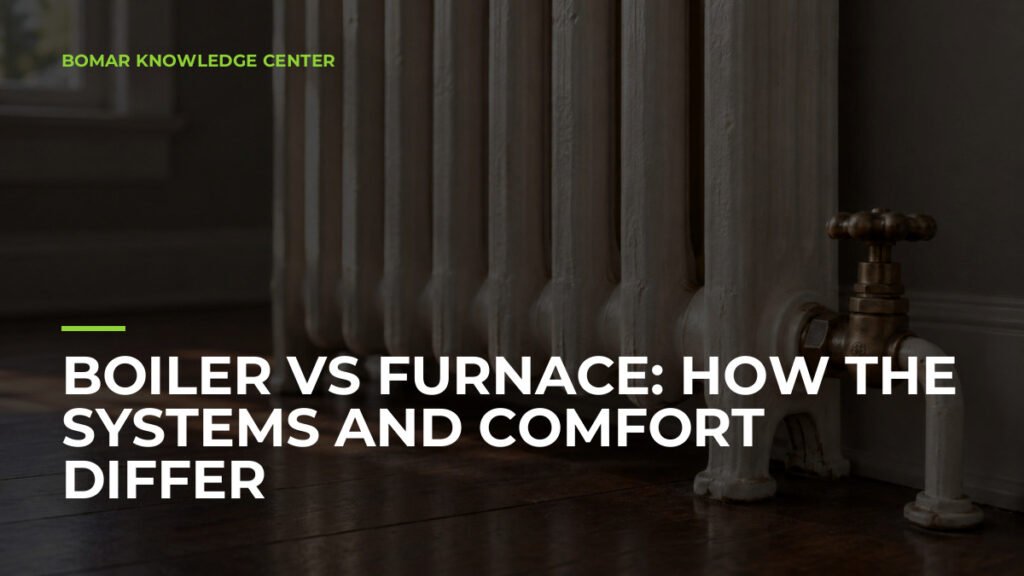
A hot-water boiler supplies heat to a connected system of piping and emitters, such as radiators, baseboards, or radiant-floor tubing. A steam boiler uses a different distribution process involving steam and returning condensate. Both are different from a furnace blowing heated air into rooms.
Weil-McLain’s boiler and furnace definitions are useful here because homeowners sometimes use the words interchangeably. The distinction is not gas versus electricity. Fuel type and distribution type are separate characteristics.
Radiators also do not heat only through radiation. The equipment can warm surrounding surfaces and transfer heat to room air. For example, U.S. Boiler describes both radiant and convected heat from its cast-iron radiators. The balance depends on the emitter and its installation.
How a Furnace Heats and Supports Cooling
A furnace transfers heat to an air stream that a blower distributes through supply ducts. Return ducts bring room air back to the equipment. In a fuel-burning furnace, combustion and the circulated household air are separated by the heat exchanger.
The same blower and duct network often support central air conditioning. During cooling, air moves across an indoor refrigerant coil instead of being heated by the burner. Trane’s AC and furnace matched-system explanation describes that relationship.
A boiler normally does not provide that central cooling air path. A boiler-heated house may use a separate ducted cooling system, ductless equipment, or room air conditioners. The right comparison therefore includes summer comfort, not only winter equipment.
Compare the Whole Installation
| Decision | Boiler-Based Heating | Furnace-Based Heating |
|---|---|---|
| Heat delivery | Water or steam piping and appropriate room emitters | Supply and return ducts with a blower |
| Existing infrastructure | Evaluate piping, emitters, zones, and controls | Evaluate ducts, returns, blower airflow, and controls |
| Central cooling | Usually requires a separate cooling distribution solution | Can share suitable ducts and indoor air-moving equipment |
| Room-by-room control | Depends on the piping and zone arrangement | Depends on duct design, controls, and any engineered zoning |
| Replacement scope | May be limited to the heat source or include distribution repairs | May be limited to equipment or include duct and airflow corrections |
This table is a comparison of project questions, not a ranking. A well-designed furnace installation can be more comfortable than a poorly maintained boiler system, and the reverse is also true.
What the Difference Feels Like in Daily Use
A homeowner who likes existing radiator comfort may have little reason to remove a functioning distribution system. Some emitters retain heat after the boiler stops firing. U.S. Boiler’s cast-iron radiator information describes that heat-retention characteristic for its products.
A forced-air system provides a different experience because heat is delivered through moving air. Register location, airflow, return paths, controls, and fan operation influence noise and room comfort. A cold bedroom is not proof that furnaces are unsuitable; it may be evidence that the particular room is not receiving the air it needs.
Think about the complaint you are trying to solve. Is the house slow to recover after a setback? Is one room cold? Are there drafts, noise, or a need for summer cooling? Those questions are more useful than asking which technology is universally “more comfortable.”
Efficiency Ratings Do Not Settle the Whole Question
Fuel-burning boilers and furnaces can be compared using AFUE, but the rating does not describe every part of the installed system or predict the exact bill. Distribution losses, house heat loss, fuel prices, controls, installation, and operating habits remain relevant.
Our HVAC efficiency-ratings guide separates equipment ratings from actual operating costs. When evaluating a change, request the assumptions behind any savings estimate. Ask which fuel price, weather conditions, equipment performance, and house load were used.
Avoid comparing an old system’s worst month with a brochure’s best operating condition. Likewise, do not assume a higher advertised rating offsets any amount of construction work required to change distribution systems.
Does Boiler Heat Avoid Dry Air or Indoor Air Problems?
A boiler and radiator system does not automatically humidify the house. Nor does a furnace automatically explain every winter dryness complaint. Indoor moisture conditions require their own assessment rather than being reduced to a boiler-versus-furnace label.
Similarly, central filtration is a feature of an air-moving system, not a guarantee of healthy indoor air. A house without central ducts still needs an appropriate plan for ventilation, moisture, and particles. A house with ducts needs suitable filtration and maintenance, not a promise that the furnace handles every pollutant.
Keep the heating choice and the air-quality assessment connected but distinct. Bomar’s indoor air quality services are a separate place to discuss those concerns instead of assuming a heating replacement will resolve them.
Keeping a Boiler and Adding Cooling
Consider an illustrative house with usable radiators, no central ducts, and a boiler that is otherwise meeting the heating load. The summer complaint is an uncomfortable upstairs and reliance on window units. That is a cooling project first, not automatic evidence that the radiator system must be removed.
A contractor can compare a separate ducted cooling installation with ductless mini-split options. The assessment should include room layout, installation access, condensate drainage, electrical requirements, maintenance, and how the cooling equipment will serve closed rooms.
A heat-pump mini-split may also supply some or all heating, depending on its design. That possibility requires a cold-weather capacity assessment. It is not a reason to disconnect an existing heat source before confirming that the new system can meet the intended winter load.
Converting From a Boiler to a Furnace
A conversion can be reasonable, but it deserves a complete scope. Where will supply ducts and return paths go? What construction and finishing are included? How will old piping or equipment be dealt with? Is the existing fuel supply or venting suitable for the proposed equipment?
Compare that total project with repairing or replacing the boiler and addressing any separate cooling needs. Request the same comfort goals in both proposals. Otherwise, a simple boiler replacement and a complete heating-and-cooling conversion can look like competing prices when they are actually buying different results.
For homes already using forced air, the reverse comparison also requires real distribution planning. Installing a boiler does not turn existing air ducts into a water-based heating system.
Questions Worth Asking at the Assessment
Ask what parts of the existing distribution system are reusable, what measurements support the proposed capacity, and what will change in the rooms. Identify any comfort problem that the proposal does not address.
Also ask about access for future maintenance, the expected control strategy, and the documents you will receive after startup. Our HVAC proposal comparison guide and boiler replacement guide can help organize the answers without comparing equipment on price alone.
Frequently Asked Questions
Is a Boiler the Same as a Water Heater?
No. A boiler generally supports space heating. Some installations also produce domestic hot water through an indirect tank or a combination appliance, but a heating boiler should not be assumed to supply every faucet in the house.
Can a Boiler Run Central Air Conditioning?
A heating boiler does not operate like an air conditioner. The house needs a separate cooling system. Suitable existing cooling ducts or a planned ductless installation can provide that function without necessarily removing boiler heat.
Does a Gas Boiler or Furnace Work Without Electricity?
Do not assume it does. Modern controls, pumps, blowers, and ignition components commonly require power. Confirm the requirements of the actual installation before making an outage plan.
Is Replacing the Same Type Always the Cheapest Option?
Not necessarily. It may avoid some conversion work, but repairs to old ducts, piping, controls, or venting can change the scope. Compare written proposals for the actual house rather than relying on a national price range.
Can a Heat Pump Replace Either System?
An air-to-air heat pump needs an appropriate air-delivery arrangement. It is not a direct substitute connected to ordinary boiler piping. Compare the complete distribution and cold-weather heating design, not just the outdoor equipment.
Talk Through the Options With Bomar
Bomar provides boiler services and heating services for Freeport, Rockford, Loves Park, and surrounding communities. When you request an assessment, explain what already works, what is uncomfortable, and whether cooling is part of the project. That keeps the recommendation centered on your house rather than on a technology label.
Sources and Further Reading
Talk with Bomar
Get help with your home comfort
Request boiler service or a system assessment from Bomar.
Keep exploring

HVAC Planning and Replacement
AFUE SEER2 and HSPF2 Explained for Homeowners
AFUE, SEER2 and HSPF2 are standardized efficiency ratings. They help you compare equipment, but they do not tell you exactly what your utility bill will be. The…
Read article : AFUE SEER2 and HSPF2 Explained for Homeowners
HVAC Knowledge Center
How to Compare HVAC Contractors in Freeport
Use a practical checklist to compare Freeport HVAC contractors, clarify installation quotes and understand service charges, coverage and follow-up.
Read article : How to Compare HVAC Contractors in Freeport
HVAC Knowledge Center
Finding Boiler Service in Belvidere: A Homeowner Checklist
Find the right boiler service in Belvidere. Ask about your system type, zone problems, diagnosis, maintenance scope and replacement requirements.
Read article : Finding Boiler Service in Belvidere: A Homeowner Checklist